




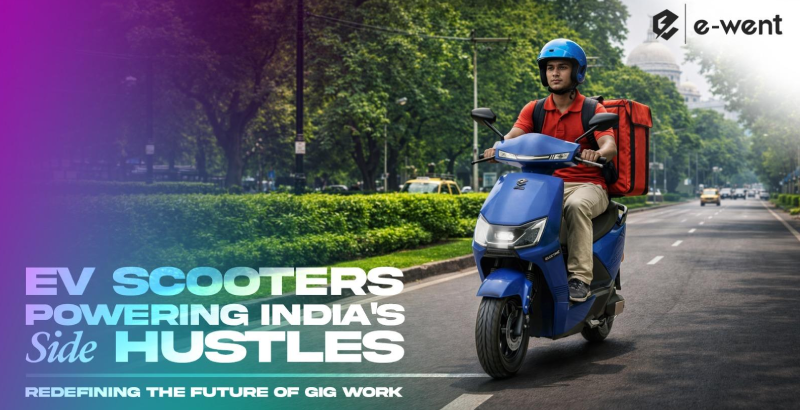
India’s side-hustle economy is growing faster than ever. People are increasingly turning to gig platforms to supplement their primary income across cities and towns. Food delivery and quick-commerce logistics as well as parcel transportation are now part of everyday urban activity. At the centre of this shift is a simple but powerful tool: the electric scooter.
Choosing a vehicle is no longer only about convenience for many riders. It has become a financial decision. The cost of fuel and the frequency of maintenance as well as the ability to cover long daily distances all directly influence earnings. This is precisely why EV scooters are emerging as the preferred option for delivery partners and even college students managing part-time work alongside their studies.
This trend suggests that electric mobility is moving beyond early adoption and becoming part of everyday economic activity.
Why Are EV Scooters Powering India’s Delivery Economy?
India’s delivery ecosystem has expanded rapidly in recent years. The rise of quick-commerce platforms and food delivery services as well as e-commerce logistics has created a large workforce that spends most of its working hours on the road. Many delivery riders travel 80 to 100 kilometres every day, particularly in busy urban markets.
Operating cost becomes a decisive factor in such conditions. Electric scooters provide a clear advantage here. They offer lower running expenses and significantly fewer mechanical components that require regular servicing compared with petrol vehicles.
This difference adds up quickly for riders completing dozens of deliveries daily. Lower daily costs allow gig workers to retain more of their earnings while reducing the uncertainty which comes with fluctuating fuel prices.
How Gig Workers Are Adopting Electric Mobility
Electric scooters are gradually becoming an integral part of the gig economy’s operational model. Several factors are encouraging delivery riders and freelance workers to transition towards EV scooters:
- Lower daily operating expenses, as electricity costs remain significantly lower than petrol.
- Reduced maintenance requirements, since electric drivetrains have fewer moving parts.
- Reliable daily range, with many scooters offering 80–150 kilometres per charge, which comfortably supports urban delivery routes.
- Ease of manoeuvrability, allowing riders to navigate dense traffic and narrow streets more efficiently.
- Growing institutional support, with delivery platforms and state governments encouraging EV adoption through incentives and partnerships.
As India’s quick-commerce and e-commerce sectors expand, these benefits make electric scooters not just a personal mobility choice but a practical business asset.
Are College Students and Part-Time Riders Driving This Trend?
An increasing number of college students and young professionals are participating in gig work to generate flexible income. Mobility must strike a balance between affordability and reliability for this group and electric scooters offer both.
Students managing delivery work or freelance errands often prefer EV scooters because they reduce day-to-day expenses. Charging overnight at home is usually enough to support a full day of riding, eliminating the need for repeated fuel stops.
This practicality aligns well with the flexible structure of gig work. Electric scooters enable young riders to earn income without facing the high operational costs traditionally associated with petrol vehicles.
What Does This Mean for the Future of Mobility?
As digital platforms continue to expand and urban service demand increases, two-wheelers will remain central to everyday mobility. However, the type of two-wheelers being used is gradually changing. Electric scooters offer the efficiency required for high-frequency travel, making them particularly suitable for delivery operations and side-hustle work.
Industry forecasts suggest that electric two-wheelers will remain one of the fastest-growing segments within India’s EV market over the next few years. As battery technology improves and charging infrastructure expands, their adoption within the gig economy is expected to grow even further.
Conclusion
India’s gig economy is transforming how mobility is used in daily life. Vehicles are no longer just tools for commuting! They are increasingly instruments for earning. Electric scooters are at the centre of this shift, providing delivery partners, freelancers, and part-time workers with a cost-efficient way to stay on the road.
EV scooters are becoming the natural choice for side-hustle mobility. As the delivery economy continues to expand, electric mobility is likely to become the default option for a new generation of riders who see their vehicles as engines of opportunity.
India's side-hustle economy is growing faster than ever. People are increasingly turning to gig platforms to supplement their primary income across cities and towns. Food delivery and quick-commerce logistics as well as parcel transportation are now part of everyday urban activity. At the centre of this shift is a simple but powerful tool: the electric scooter. Choosing a vehicle is no longer only about convenience for many riders. It has become a financial decision. The cost of fuel and the frequency of maintenance as well as the ability to cover long daily distances all directly influence earnings. This is precisely why EV scooters are emerging as the preferred option for delivery partners and even college students
managing part-time work alongside their studies.
This trend suggests that electric mobility is moving beyond early adoption and becoming part of everyday economic activity.